How Casino Films Use Uniforms to Shape Trust
Casino uniforms in film shape how audiences read trust, service and status. Learn to analyse costume choices as storytelling, not as a map of workplace hierarchy.
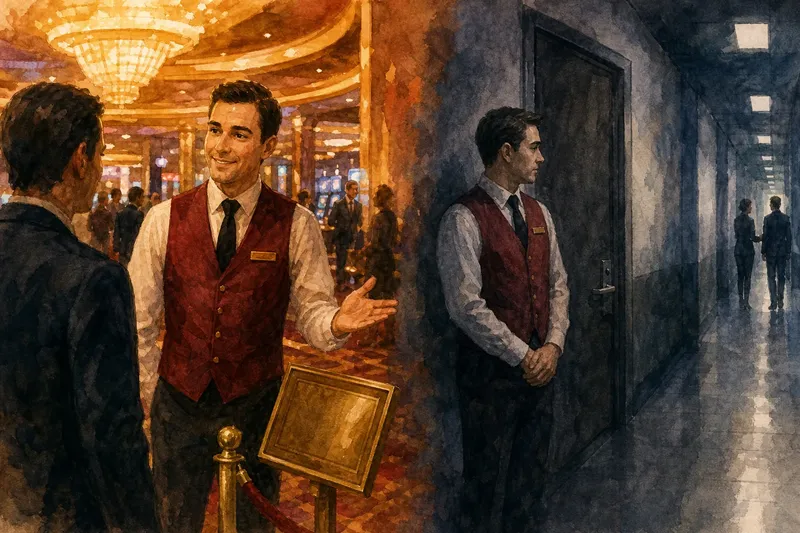
A guest steps into a casino film’s amber-lit lobby, where a host in a burgundy waistcoat smiles beside a brass sign. The same host later appears in a stark corridor, silent beside a closed door. Casino uniforms in film help turn that change of setting into a change in mood.
Costume analysis becomes more revealing when it follows the film’s visual storytelling: colour, silhouette, repetition and contrast. Rather than treating a jacket as a clue to a real job title, ask how the costume steers attention and feeling from scene to scene.
Casino uniforms in film create visual patterns
A single outfit can connect scenes that would otherwise feel unrelated. A burgundy waistcoat repeated across a lobby, a gaming floor and a service corridor gives the character visual continuity; a sudden change to a plain shirt can mark a shift in tone or circumstance.
Notice the choices a film makes around the clothing. A close-up may foreground a badge or cuff, while a wide shot may make one uniform blend into a crowd. The camera, lighting and blocking work alongside the costume, so the effect belongs to the whole scene rather than to the garment alone.
Colour and silhouette guide the audience’s attention
Dark, sharply tailored clothing can make a character look visually distinct against a bright room. Softer colours or looser shapes may make another character seem less formal in the same frame. These are interpretations of visual design, not fixed meanings: the surrounding palette and the character’s movement can alter the effect.
Try describing what is on screen before naming the impression. “A dark jacket stands out against a pale wall” is a visible detail; “the character looks intimidating” is an interpretation. Keeping those statements separate makes the reading more precise and easier to discuss.
Repeated costumes can shape the film’s sense of belonging
When several characters wear similar outfits, the film creates a visual group. That repetition can make the group feel coordinated, anonymous or ceremonial, depending on framing and performance. A contrasting costume may draw the eye towards one person without telling the audience exactly what that person does.
Set design can strengthen or complicate the pattern. Matching jackets against identical counters may make a scene feel orderly; the same jackets in a cluttered room may contribute to a more unsettled mood. Focus on how the film combines these elements rather than assigning a universal meaning to a uniform.
What should viewers ask about casino costume design?
Why does a film repeat the same outfit across scenes?
Repetition helps an audience recognise a character or group, and it can tie separate locations together visually. Compare what changes around the outfit—such as lighting, framing or behaviour—to see whether the film gives that repetition a new tone.
Can colour alone tell me what a character represents?
Colour can guide attention and contribute to mood, but its effect depends on the scene around it. Describe the colour and contrast first, then explain the impression without treating it as a universal code.
How do costume and camera work together?
A close-up can make a small detail prominent, while a distant shot may turn the same clothing into part of a larger pattern. Notice where the camera places the character and what else occupies the frame before deciding what the outfit contributes.
What if the costume seems to contradict the character’s behaviour?
The contrast may be part of the film’s characterisation, or it may simply complicate the scene’s mood. Point to both the visible clothing and the behaviour, then leave room for more than one interpretation.
A scene-by-scene reading keeps costume analysis specific
Imagine a fictional film with two scenes featuring the same host. At the entrance, the host wears a burgundy waistcoat under warm lighting and greets a guest; later, the host wears the same outfit in a cool, narrow corridor and stands quietly while another character speaks. First, note the repeated waistcoat. Next, record the changed setting, lighting and action. The resulting reading is that the film uses one costume to connect the scenes while changing its atmosphere through visual context; the clothing itself does not explain the host’s duties.
This method also helps when a detail is ambiguous. If the film gives no close-up of a badge, for instance, there is no need to make it central to the interpretation; the stronger point may be the contrast between the two settings.
Separate costume design from workplace hierarchy
Casino uniforms in film belong first to the film’s design: they can support character recognition, mood and composition. A scene may offer dialogue or action that establishes something about a fictional character, but clothing alone does not supply that information.
For a real-world question about a casino or its staff, rely on the venue’s published information or ask an appropriate staff member. That keeps an interpretation of screen imagery distinct from a practical judgement about a real person or institution.
Use visible details to choose a careful interpretation
Check what the scene actually shows, then decide whether to describe a detail, discuss an impression or leave the meaning open. Each choice below pairs an observation with a decision and an alternative action.
- Observation: A badge appears, but its wording is unreadable. If the camera draws attention to it, then describe the badge as visually emphasised; otherwise, treat it as a minor costume detail.
- Observation: Several staff characters wear matching jackets. If their repeated outfits form a clear visual group, then discuss that pattern; otherwise, describe each outfit without assigning the characters a shared identity.
- Observation: A character in uniform gives a guest directions. If the scene centres on the exchange, then describe the service interaction; otherwise, focus on the action the scene foregrounds instead.
- Observation: A complaint is passed from one character to another. If dialogue clarifies the handover, then describe the responsibility the story establishes; otherwise, say the film leaves the process unclear.
- Observation: A formal outfit accompanies casual behaviour. If the contrast is visible, then discuss how the scene places those elements together; otherwise, describe the behaviour without forcing a contrast.
- Observation: A character’s position is never explained. If the story supplies no supporting dialogue or action, then leave the role unspecified; otherwise, describe only what the scene demonstrates.
Casino uniforms in film shape trust through visual choices such as repetition, contrast and framing. The most useful question is not what a costume proves, but what the scene makes you notice—and which details support that reading.