Casino Warnings and Welcome Messages Do Different Jobs
Casino warnings and welcome messages serve different purposes. Learn how to read their tone, audience and next step before deciding what to do.
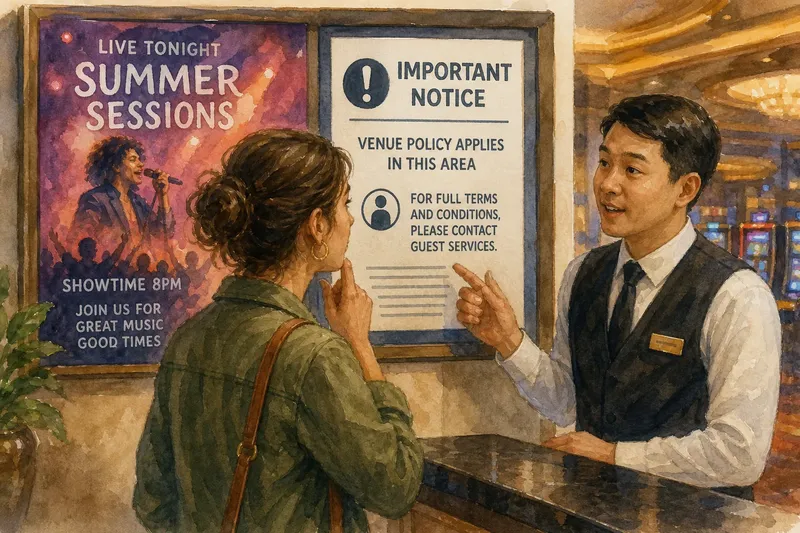
A bright poster for a live show can hang beside a sober notice about a venue policy. Casino warnings and welcome messages may share a wall, but reading them well means noticing what each is trying to communicate—and what it leaves unsaid.
Read the purpose behind the tone
A welcome message introduces an experience: a show, dining, or an invitation to ask about an amenity. Its upbeat tone is part of the invitation, not an explanation of every condition attached to visiting.
A warning or policy notice has a different job. It may flag a restriction, describe a process or direct attention to a potential concern. Its wording should help a reader understand the subject, rather than relying on a stern tone to supply missing detail.
Tone alone can mislead. A friendly notice may contain important conditions, while a formal warning may simply explain a routine procedure. Read the actual words and consider what decision they bear on.
Separate an invitation from a claim about conditions
When a welcome message mentions an event or amenity, treat it as information about that offer, not as a complete account of venue policies. If conditions could affect your choice, look for the venue’s published terms or ask which team handles them.
A warning also has limits: a short sign may alert readers to a matter without explaining every circumstance. Where the wording is unclear, ask what the notice applies to and where the fuller explanation is available. A sign is a starting point for understanding, not a substitute for the relevant details.
Use the message to identify the right conversation
Messages can point towards different kinds of conversation. A visitor might ask venue staff about a published policy; a personal concern may be better suited to an independent support organisation. Those routes are not interchangeable, so check who is responsible before sharing sensitive details.
Imagine a visitor sees an invented poster for a music event beside an invented notice stating that a venue policy applies in a particular area. The visitor wants to know whether that policy affects their plans, so they ask the staff member named on the notice where its full terms are published. If the staff member directs them to those terms, the visitor can decide whether to proceed; if the question is outside that staff member’s role, the visitor can ask which team handles it.
What should you ask when a message is unclear?
Does this notice apply to my situation?
Ask which circumstances the message covers and where the complete terms are available. If the answer remains unclear, ask who is responsible for explaining the relevant policy before acting on an assumption.
Is this an invitation or a statement of policy?
Look for wording that describes an event or amenity versus wording that sets out a condition or process. If both appear together, treat them as separate claims and check the terms that matter to your decision.
Who can explain the matter?
Check whether the notice names a team, desk or service. If it does not, ask venue staff where to direct the question; for a personal concern, ask whether an independent support organisation is available and how to contact it.
What should I do if the wording is hard to access?
Ask for the information in a more usable form, such as a larger-print copy or a staff explanation. If the first contact cannot help, ask which venue team can provide an accessible version.
Review a casino message before acting on it
These checks help readers distinguish what a message says from what they still need to learn. Each observation points to a practical next action.
- Audience: Check whether the message addresses visitors, staff or another group. If the audience is unclear, ask whom it is intended for; if it names a group you do not belong to, ask whether the information also applies to you.
- Purpose: Check whether the message promotes an event, explains a policy or raises a concern. If it combines purposes, separate the claims and ask about the one affecting your decision; if it has one clear purpose, use it only for that purpose.
- Scope: Check whether the notice says where or when a condition applies. If it omits the relevant scope, request the fuller terms; if the scope is stated, compare it with your situation before deciding.
- Source: Check whether the message identifies the venue, team or organisation responsible. If no source is named, ask who issued it; if a source is named, use that organisation’s appropriate contact route.
- Next action: Check whether the message gives a useful action, such as asking a named team. If no action is provided, ask where to direct the question; if one is provided, follow it only for the stated purpose.
- Access: Check whether the text can be read and understood in its location. If it is obscured or difficult to use, ask for an accessible version or an explanation; if it is readable, consider whether its details answer your particular question.
- Support route: Check whether the message distinguishes venue assistance from outside support. If responsibility is unclear, ask who handles the concern; if an independent service is named, use its stated contact details for matters within its remit.
These checks keep casino warnings and welcome messages in their proper roles: one can invite, another can alert, and neither should be mistaken for information it does not contain. When a message leaves a decision unresolved, identify the missing detail and ask the organisation responsible for it through a suitable contact route.